The Cambridge Companion to Postmodernism by Steven Connor
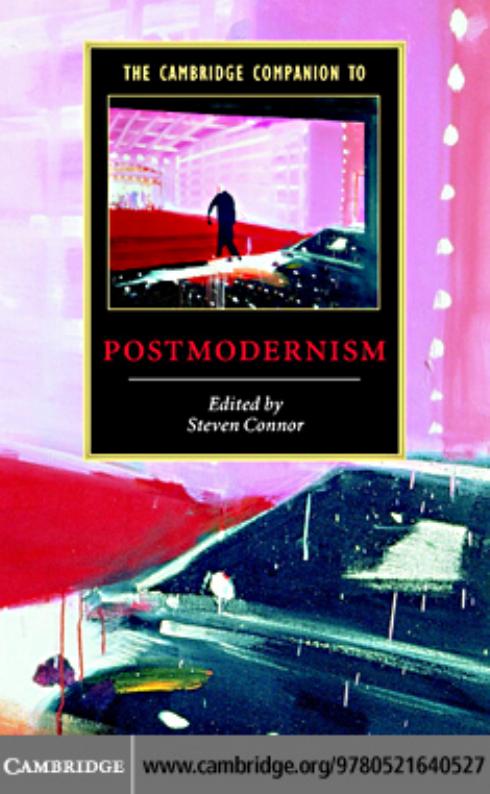
Author:Steven Connor
Language: eng
Format: epub, pdf
Publisher: Cambridge University Press
7
URSULA K. HEISE
Science, technology, and postmodernism
Postmodernism and the legacy of the enlightenment
Between the 1970s and the late 1990s, the concept of the “postmodern” was associated with a wide range of different meanings. It could designate a chronological period, a particular style found in some contemporary artworks and literary texts, a property of social structures at the end of the twentieth century, a change in the values of certain societies, or a specific way of thinking theoretically about such issues as language, knowledge, or identity. Different interpretations of these basic meanings further add to the complexity. Understood as an historical period, the postmodern could either follow a modernity defined by political, social, cultural, and economic institutions that had emerged in the late eighteenth century, or succeed the cultural and artistic modernism that had characterized the era from approximately the 1850s to World War II. Viewed as an aesthetic style, the postmodern could refer to quite different features depending on whether it was studied in an old historical art form such as architecture, which had developed a distinctive “modern” style beforehand, or a very young art form such as film, which had evolved only during the modernist period.1 Some of this terminological ambivalence also attaches to the relationship between science, technology, and postmodernism. On the one hand, one can designate as “postmodern” some of the latest scientific and technological achievements, particularly those that are culturally perceived as ushering in a different historical era and type of society. On the other hand, scientific knowledge and technological rationality have been seriously challenged by postmodern modes of thought that more generally question fundamental Enlightenment assumptions about human subjectivity, knowledge, and progress.
In the second half of the twentieth century, some scientific insights and technological innovations have particularly contributed to shaping the sense of a new historical age. Nuclear technology (both bombs and power plants), journeys to the Moon and Mars, television, global communications networks, the discovery of DNA, in vitro fertilization, the cloning of animals, the human genome project, digital technology from the personal computer to the World Wide Web, and environmental disasters such as those at Seveso, Bhopal, and Chernobyl have all contributed to defining the postmodern period. The intensive push of technoscientific innovation in the decades following World War II opened up new fields whose impacts have been perceived, experienced, and vigorously discussed among a broad public: computer technology and biotechnology are two of the most salient areas that have given rise to utopian hopes as well as to apocalyptic fears, and that have most strikingly created the sense of an epochal break. The widespread resistance to nuclear technology and the emergence of environmentalism as a perceptible social and political force point to a different dimension of technoscientific postmodernism: the rise of popular ambivalence vis-à-vis science and technology as unequivocally positive forces, and toward the narratives of progress and mastery of nature with which they have conventionally been associated.2 These developments will be discussed in the next section of this essay (“Postmodern technologies”).
The ambivalence
Download
The Cambridge Companion to Postmodernism by Steven Connor.pdf
This site does not store any files on its server. We only index and link to content provided by other sites. Please contact the content providers to delete copyright contents if any and email us, we'll remove relevant links or contents immediately.
| Anthropology | Archaeology |
| Philosophy | Politics & Government |
| Social Sciences | Sociology |
| Women's Studies |
The remains of the day by Kazuo Ishiguro(9081)
Tools of Titans by Timothy Ferriss(8489)
Giovanni's Room by James Baldwin(7432)
The Black Swan by Nassim Nicholas Taleb(7193)
Inner Engineering: A Yogi's Guide to Joy by Sadhguru(6835)
The Way of Zen by Alan W. Watts(6669)
The Power of Now: A Guide to Spiritual Enlightenment by Eckhart Tolle(5854)
Asking the Right Questions: A Guide to Critical Thinking by M. Neil Browne & Stuart M. Keeley(5831)
The Six Wives Of Henry VIII (WOMEN IN HISTORY) by Fraser Antonia(5557)
Astrophysics for People in a Hurry by Neil DeGrasse Tyson(5224)
Housekeeping by Marilynne Robinson(4502)
Double Down (Diary of a Wimpy Kid Book 11) by Jeff Kinney(4332)
12 Rules for Life by Jordan B. Peterson(4331)
Ikigai by Héctor García & Francesc Miralles(4310)
The Ethical Slut by Janet W. Hardy(4307)
Skin in the Game by Nassim Nicholas Taleb(4305)
The Art of Happiness by The Dalai Lama(4167)
Skin in the Game: Hidden Asymmetries in Daily Life by Nassim Nicholas Taleb(4050)
Walking by Henry David Thoreau(3998)
